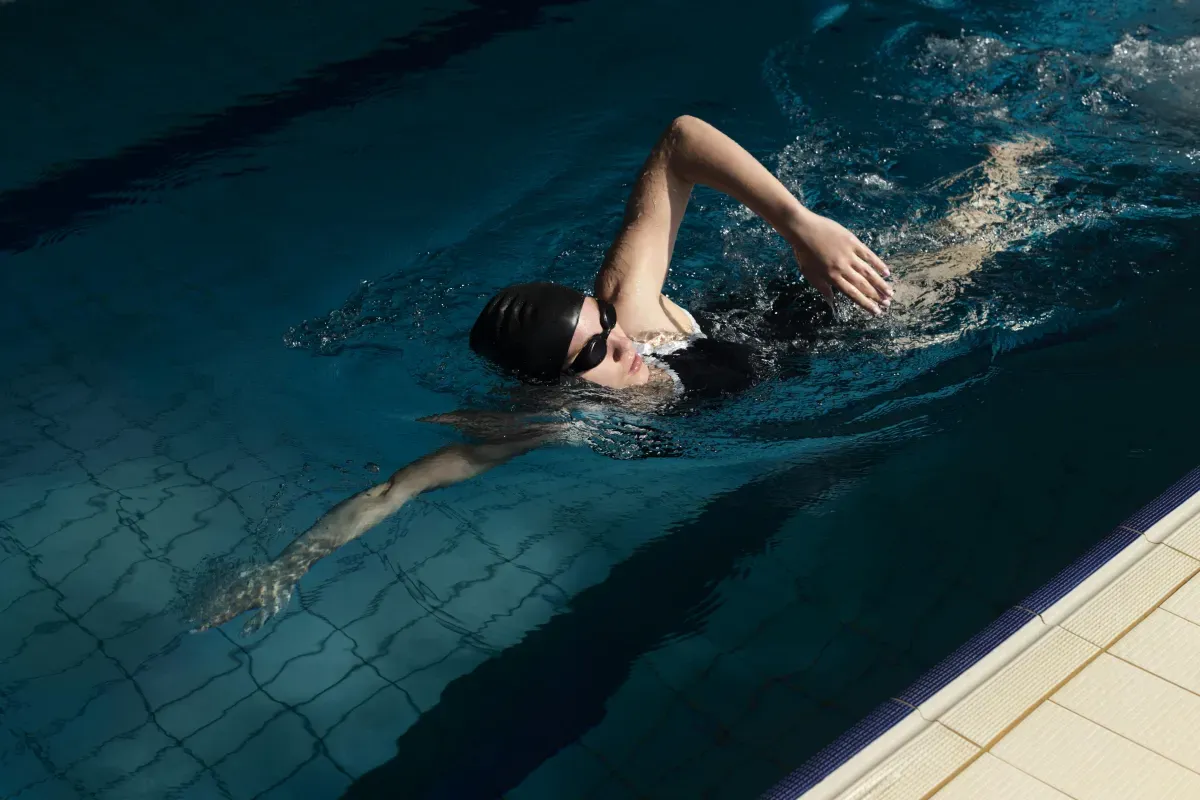
Swimming is one of the most technically demanding sports you can do. You’re asking your body to produce force in an unstable environment, over and over, often for thousands of metres per session. The repetitive load adds up quickly — competitive swimmers do somewhere between 1 and 2 million shoulder rotations per year. That’s not a typo.
I see a lot of swimmers at the clinic, from kids doing club sessions at Everton Park or Leasowe to triathletes training for Ironman Wales. Most of them come in with shoulder pain. Some have lower back problems. A few have knee issues, usually breaststrokers. The pattern is rarely random — your stroke dictates your injury risk.
Swimmer’s shoulder accounts for up to 70% of swimming injuries, driven by the repetitive overhead motion. Strengthening your rotator cuff and scapular stabilisers — plus managing training volume — is the best way to stay in the pool pain-free.
This post breaks down the most common swimming injuries by stroke, explains what’s actually going wrong, and gives you practical strategies to keep training without making things worse.
Swimmer’s Shoulder: What It Actually Is
“Swimmer’s shoulder” is the umbrella term for shoulder pain in swimmers, but it’s not particularly helpful on its own. What you’re usually dealing with is rotator cuff overload — the small stabilising muscles around your shoulder getting fatigued and inflamed from repetitive overhead work.
It’s not classic impingement in the way you’d see in an older adult with a degenerative rotator cuff. It’s more about volume, mechanics, and fatigue. Your rotator cuff muscles (supraspinatus, infraspinatus, subscapularis, teres minor) are meant to stabilise your shoulder joint while your bigger muscles (deltoid, lats, pecs) generate power. When you’re tired, when your technique breaks down, or when you’re doing too much volume too quickly, those small stabilisers get overloaded.
The result is anterior shoulder pain (front of the shoulder), sometimes radiating down into the upper arm. It often starts as a dull ache during warm-up, eases off mid-session, then comes back with a vengeance after you get out of the pool. Left unchecked, it gets worse — you start losing range of motion, your stroke compensates, and you end up with a vicious cycle.
The frustrating part is that swimmers are often hypermobile. You’ve spent years stretching to improve your streamline, your catch, your rotation. That flexibility is an asset in the water, but it’s a double-edged sword — hypermobile shoulders need more muscular control to stay stable, and that’s exactly what gets compromised when you’re fatigued. This is where the tendon pathology continuum applies (Cook & Purdam, 2009) — the progression from reactive tendon response to degenerative tendinopathy when overload continues unchecked.
Injury Patterns by Stroke
Different strokes load your body in different ways. Here’s the breakdown:
Freestyle
Shoulder (rotator cuff overload, anterior instability). Most common in high-volume swimmers. Often develops from poor breathing technique, crossing midline on entry, or dropping the elbow during the pull phase.
Breaststroke
Knee (medial collateral ligament stress from whip kick), lower back (hyperextension during recovery). Knees take a beating from the outward snap of the kick, especially in younger swimmers with narrow stance.
Butterfly
Shoulder (similar to freestyle but higher load), lower back (repetitive hyperextension). The undulation forces your lumbar spine into end-range extension dozens of times per length — adds up fast.
Backstroke
Shoulder (rotator cuff, often posterior impingement). Less common than freestyle injuries but still present, especially in swimmers who over-rotate or have poor scapular control during the recovery phase.
Freestyle and butterfly shoulder issues are about repetitive overhead loading. Breaststroke knee pain is biomechanical — the whip kick puts valgus stress (inward collapse) on the knee, stretching the medial collateral ligament. Lower back pain in breaststroke and butterfly is about hyperextension — you’re forcing your spine into end-range repeatedly, and if your core isn’t controlling that movement, your facet joints and discs take the load.
The Volume Problem: Training Errors That Cause Injuries
Most swimming injuries don’t come from a single event — you don’t “do your shoulder in” catching a bad wave. They accumulate over weeks or months of training. The most common culprits are:
Sudden volume spikes. Going from 10k per week to 20k per week because you’ve got a competition coming up is asking for trouble. Your tissues need time to adapt. A 10-15% weekly increase is the general rule, but even that’s aggressive if you’re already carrying a niggle.
Training aids that increase load. Paddles and pull buoys are brilliant tools for building strength and isolating your pull, but they massively increase the load on your shoulders. Paddles make your hand bigger, which means more resistance and more torque through your rotator cuff. Pull buoys eliminate your kick, so your upper body does all the work. If you’re using these tools for 30-40% of your session and your shoulders are already tired, you’re setting yourself up for overload.
Training aids are effective, but they’re also high-load. If your shoulders are already sore, reduce or eliminate paddles and pull buoy work until you’ve got your symptoms under control. Focus on technique, single-arm drills, and kick sets instead.
Poor breathing mechanics. In freestyle, a lot of shoulder pain comes from asymmetric breathing or over-rotation to breathe. If you only breathe to one side, you’re loading that shoulder differently every stroke. If you’re lifting your head instead of rotating your whole body, you’re compromising your streamline and forcing your shoulder into awkward positions.
Ignoring early warning signs. Swimmers tend to push through discomfort. A bit of shoulder soreness after a hard session is normal. Persistent pain that doesn’t settle overnight, or pain during the session that changes your stroke, is not. If you’re modifying your technique to avoid pain, you need to back off and address it.
Breaststroke Knee: The Hidden Issue
Breaststroke knee doesn’t get as much attention as swimmer’s shoulder, but it’s incredibly common in competitive breaststrokers. The whip kick involves a rapid outward snap of the lower leg while your knee is bent — it’s a powerful movement, but it puts significant stress on the medial collateral ligament (MCL) and the medial meniscus.
I see this a lot in younger swimmers who’ve been encouraged to narrow their kick for speed. The narrower your stance, the more valgus stress you’re putting on the knee. Over time, that repetitive load inflames the MCL, and you end up with medial knee pain that gets worse during and after training.
The fix is twofold: strengthen your hip abductors and adductors (glutes and inner thighs) to control the movement, and refine your kick technique. A slightly wider, more controlled kick with less snap reduces the stress on your knee. It might feel slower initially, but it’s a lot better than sitting out for six weeks with an MCL strain.
If you’re a breaststroker and you’re getting medial knee pain, get it checked early. We see plenty of swimmers at the clinic from clubs around Chester and Cheshire, and breaststroke knee is one of the easier issues to manage if you catch it before it becomes chronic.
Lower Back Pain in Butterfly and Breaststroke
Butterfly and breaststroke both force your lower back into hyperextension — the arch you create during the undulation or recovery phase. If you’re doing 50-100 fly or breast strokes per session, that’s 50-100 repetitions of end-range lumbar extension. Your facet joints (the small joints at the back of your spine) and your discs don’t love that.
The injury risk is higher if your core isn’t controlling the movement. Your abs and obliques should be stabilising your spine during the stroke, but if they’re weak or fatigued, your lower back does all the work. You end up with a dull, central ache across your lower back that gets worse as the session goes on.
The solution is dryland core training — planks, dead bugs, bird dogs, Pallof presses. You need anti-extension strength, which means teaching your abs to resist the arch rather than just doing endless sit-ups. In the pool, focus on engaging your core during the undulation and recovery phases. It should feel like you’re pulling your ribs down towards your pelvis as you drive forward.
For more context on managing back pain, we’ve got a full breakdown of common causes and treatment approaches.
Dryland Training for Swimmers: What Actually Helps
Most swimmers do some form of dryland, but not all dryland is created equal. If you’re just doing endless press-ups and sit-ups, you’re missing the point. Swimmers need rotator cuff strength, scapular stability, and core control. Research shows that strength training, when done correctly, reduces sports injuries by 68% (Lauersen et al., 2014). Here’s what that looks like in practice:
Rotator Cuff Strengthening
External and internal rotation exercises with resistance bands or light dumbbells. Focus on controlled, slow movements. 3 sets of 12-15 reps, 2-3 times per week. The goal is endurance, not max strength.
Scapular Stability
Exercises that teach your shoulder blade to move properly. Y-raises, T-raises, prone scapular retractions, wall slides. Your shoulder blade should glide smoothly across your ribcage — if it's winging out or hiking up, your shoulder is compensating.
Core Anti-Extension Work
Planks, dead bugs, Pallof presses, and bird dogs. These teach your core to resist movement rather than create it. Essential for butterfly and breaststroke swimmers who need to control lumbar hyperextension.
Posterior Chain Strengthening
Deadlifts, Romanian deadlifts, and glute bridges. Swimmers tend to be quad-dominant and anterior-chain dominant. Building strength in your glutes, hamstrings, and back extensors balances that out and reduces injury risk.
You don’t need a full gym session four times a week. Two 20-30 minute dryland sessions focused on these areas will make a measurable difference. The swimmers I work with who stay injury-free are the ones who take dryland seriously, not just as a box-ticking exercise but as an essential part of their training.
For swimmers dealing with shoulder pain or rotator cuff injuries, targeted dryland work is non-negotiable.
When to Modify Training (and When to Stop)
This is the question everyone asks: can I keep swimming, or do I need to stop completely?
The answer depends on the severity and the pattern. If your shoulder is sore but the pain isn’t changing your stroke, and it settles overnight, you can probably keep training with modifications. Here’s what that looks like:
- Reduce volume by 30-50%. You’re still getting a training stimulus, but you’re not digging yourself into a deeper hole.
- Cut out paddles and pull buoy work. These are high-load tools — save them for when your shoulder is healthy.
- Switch to single-arm drills and kick sets. Single-arm freestyle isolates each side and reduces overall load. Kick sets give your shoulders a break entirely.
- Focus on technique. Use the modified sessions to work on your catch, your breathing, your streamline. You’ll come out the other side a better swimmer.
If your shoulder pain is sharp, if it’s changing your stroke mid-session, or if it’s not settling between sessions, you need to stop and get it assessed. Pushing through that kind of pain doesn’t make you tough — it just turns a manageable issue into a chronic one.
I’ve worked with plenty of triathletes around the Wirral who’ve tried to train through shoulder pain in the lead-up to a race. The ones who modify early and get treatment usually make it to the start line. The ones who ignore it often end up pulling out or racing injured and making things worse.
When to Get Help
If you’ve backed off your training, you’ve modified your sessions, and your shoulder or back pain isn’t improving within 2-3 weeks, it’s time to get it checked. The same goes for knee pain that’s getting worse despite reducing your breaststroke volume.
At Professional Sports Physio, we assess swimmers regularly — we’ll look at your shoulder mechanics, your scapular control, your core stability, and your training load. We’ll also ask about your stroke technique, your dryland routine, and your competition schedule. The goal is to get you back in the pool without the pain coming straight back.
Most swimming injuries respond well to a combination of load management, targeted strengthening, and technique refinement. You don’t usually need to stop swimming completely — you just need to train smarter while your body adapts.
If you’re dealing with persistent knee pain from breaststroke or shoulder issues that aren’t settling, don’t wait until it’s chronic. Get it assessed, get a plan, and get back to training properly.
Swimming is a brilliant sport, but it’s unforgiving if you ignore the warning signs. Look after your shoulders, strengthen your core, and respect the volume. Your body will thank you for it.
Related Articles

Why Desk Workers Get the Same Injuries as Athletes
You don't need to be a footballer to get a repetitive strain injury. Desk workers develop the same tendon, back, and neck problems as athletes — just from different loads. Here's why and what to do about it.
Common Gym Injuries and How to Avoid Them
Shoulder impingement from bench press. Lower back pain from deadlifts. Knee pain from squats. The most common gym injuries, why they happen, and how to train around them.
Pre-Season Injury Prevention for Football and Rugby Players
Pre-season is where injuries are made or prevented. A physiotherapist's guide to preparing your body for football and rugby — covering the exercises, load management, and common mistakes.